Foreign Movie
Movie Review: ‘Mala’ – Indian Mythology Meets Slow-Burning Psychological Terror


Indian horror has increasingly found itself at a fascinating crossroads, where folklore, spirituality, and psychological unease meet to create stories that feel distinct from other parts of the world.
‘Mala‘, written by Nisha Sabharwal and directed by Trishul Thejasvi, confidently embraces that direction. Rather than relying on familiar jump scares or conventional haunted-house tropes, it leans into the unsettling territory of tantric traditions, inherited trauma, and the frightening possibility that our past can shape our destiny in ways we neither understand nor escape.
The story follows Reema, who inherits an abandoned resort on a secluded tropical island after the death of her aunt. Accompanied by her three closest friends, what begins as an exploration of an unexpected inheritance quickly transforms into something far more sinister. The island seems frozen in secrets, its residents guarded and suspicious, while the resort itself carries an unsettling presence that grows stronger with every passing moment.
Their arrival is marked by an awkward welcome from Robert (played by Nikhil Kamkolkar), whose uneasy demeanour hints that the island is hiding more than abandoned buildings and forgotten memories. Although his behaviour initially feels merely peculiar, it soon becomes clear that the discomfort surrounding the resort runs much deeper. Strange blood stains appear, unsettling visions become increasingly difficult to dismiss, and Reema slowly discovers that her connection to the island extends far beyond inheritance. The deeper she digs, the more she uncovers a family history intertwined with tantric rituals, black magic, and a legacy she cannot simply walk away from.
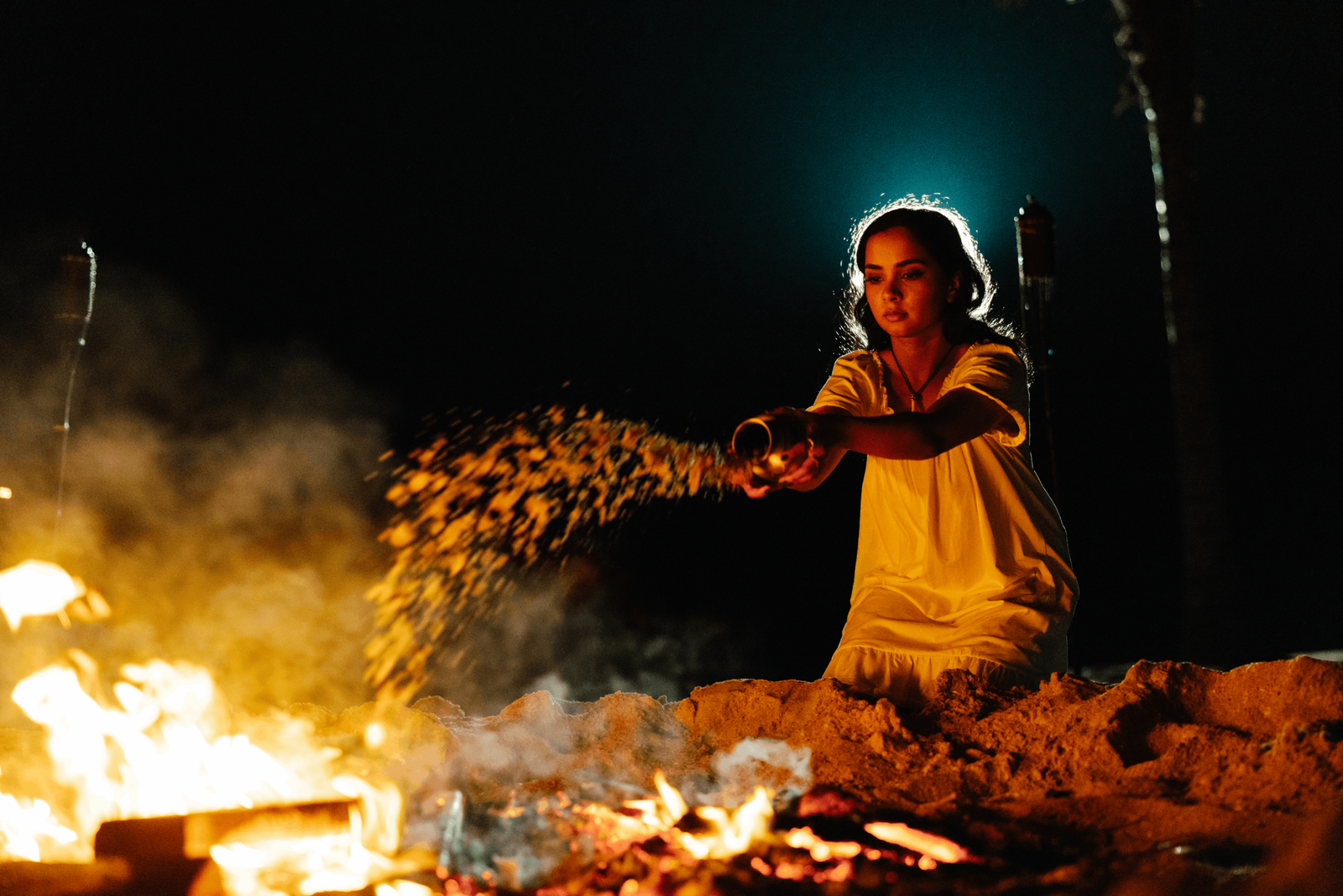
One of ‘Mala’‘s greatest strengths is the atmosphere it establishes. From its opening moments, the film sustains an ominous presence that never truly loosens its grip. There is a constant feeling that something is watching, waiting, or quietly manipulating events behind the scenes. Rather than overwhelming viewers with endless scares, the film patiently builds psychological tension, allowing uncertainty to become its most effective weapon. The island itself almost feels like another character, beautiful enough to draw you in, yet unsettling enough to make you question every corner and every silence.
This approach aligns perfectly with Trishul Thejasvi‘s ambition to create an Indian horror film that moves beyond familiar cultural stereotypes. Instead of defining its characters by their ethnicity, ‘Mala’ simply allows them to exist within a story where Indian spirituality naturally informs the mythology rather than becoming its sole identity. The result is a horror film that feels culturally rooted without ever becoming culturally restrictive.
The incorporation of South Asian mythology and tantric traditions gives the narrative a refreshing identity. Rather than serving as exposition, these spiritual elements become part of the film’s psychological landscape, blurring the line between reality, memory, and supernatural influence. Even viewers like myself who are unfamiliar with these traditions can appreciate the unsettling mysticism they bring to the story.
The performances feel adequate for the film’s scale. Through it all, the actors remain committed, the atmosphere rarely falters, and the story consistently prioritises psychological unease over spectacle. Indigo Sabharwal delivers convincingly on her portrayal of Reema. She is both curious, uninformed and afraid. Then we see the shift in her as she begins to discover more about her family’s secrets. Nikhil Kamkolkar also does a decent job at setting the film’s tone when he is introduced to us.
Like many psychological horror films, however, this one too asks its audience to surrender certainty. The climax intentionally embraces ambiguity, rewarding viewers who enjoy piecing together symbolism and emotional subtext rather than expecting every mystery to be neatly explained. While some may find themselves momentarily disoriented, the ending ultimately feels earned. It doesn’t leave behind frustrating loose ends so much as it invites reflection, allowing the story to linger well after the credits roll.

That said, the narrative occasionally moves too quickly through some of its most intriguing ideas. The mythology surrounding the island, its rituals, and Reema’s family history is compelling enough to deserve greater exploration. A deeper understanding of the island’s traditions and the role her aunt played within them would have considerably strengthened the emotional and supernatural stakes. Likewise, a few of Reema’s decisions feel underdeveloped, making it difficult at times to understand the motivations driving some of her actions fully.
Fortunately, these shortcomings do little to diminish the film’s overall impact. It’s a film more interested in planting disturbing images in your mind than delivering quick thrills, trusting the audience to engage with its layered storytelling.
I will score this film 6.5/10. Granted, it is not a conventional horror film, nor does it aspire to be one. It embraces mystery, cultural mythology, and psychological dread to tell a story about inheritance, identity, and the terrifying weight of family secrets. While some narrative threads could have benefited from greater clarity and deeper world-building, Trishul Thejasvi delivers an ambitious and refreshingly original horror experience that expands the possibilities of Indian genre filmmaking.