Featured Articles
Against the Odds, Adeoye Adetunji on Making ‘The Travails of Àjàdí’.


Nigerian filmmaker, animator, illustrator and production designer Adeoye Adetunji has always been fascinated by the art of creating worlds. From building matchstick ninjas and cardboard houses as a child to designing elaborate worlds for music videos and eventually finding his creative home in stop-motion animation, his journey has been shaped by a desire to bring the things in his imagination to life.
His latest short animation, The Travails of Àjàdí, is perhaps the clearest representation yet of that creative journey.
The 11-minute Yoruba-language stop-motion film follows Àjàdí, a fisherman who survives a violent storm at sea and confronts a mysterious divine presence. What begins as an outpouring of frustration over a life filled with hardship eventually becomes a spiritual reckoning, forcing him to reconsider the meaning of the struggles he has experienced. For Adeoye Adetunji, however, the story was much more personal than he initially realised. Written during a difficult period in his own life, Àjàdí eventually became a reflection of his own struggles and, in his words, a personal message to himself.
What makes the film even more remarkable is the way it was made. With very limited funds, he relied on his creativity and technical knowledge to build the film’s miniature world, animate the sea, construct rigs for complex camera movements and even shoot with a phone rather than a dedicated camera. His decision to tell the story in Yoruba also came from a desire for authenticity, leading him to discard the film’s original English recordings and travel from Lagos to Ilorin to find the voices and delivery he wanted.
The result has already earned significant recognition, including Best Animation wins at AFRIFF and the Zuma International Film Festival, an AMAA nomination and a selection for the Perspectives programme at the Annecy International Animation Film Festival.
But for this ‘seasoned’ filmmaker, the bigger picture goes beyond his own success. He believes Nigerian stop-motion has a future and is actively working to make that future possible by sharing his process and helping other creatives understand that they can build within the medium without waiting for someone else to create the industry first.
In this interview, Adeoye Adetunji talks about his unconventional journey into filmmaking, discovering stop-motion, the personal story behind The Travails of Àjàdí, creating the film with limited resources, the importance of Yoruba language and authenticity, and his hopes for the future of stop-motion animation in Nigeria.
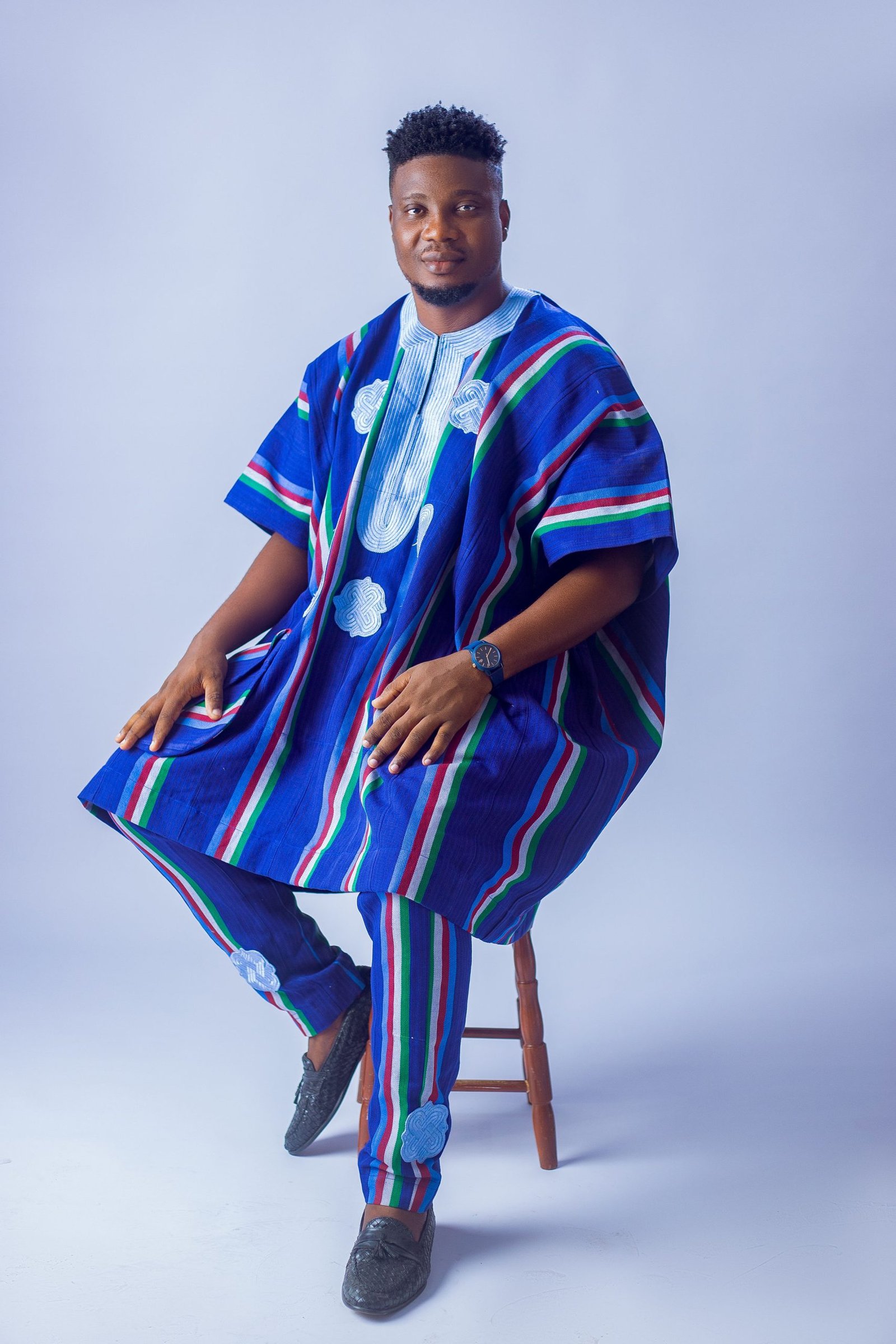
Adeoye Adetunji
- Adeoye, can you share with us briefly what your journey as a filmmaker has been so far?
Adeoye: Thank you so very much for having me. It’s a pleasure. My filmmaking journey started for me as a kid, even when I didn’t know the labels for what I was doing. I watched a movie called *American Ninja* as a child, and there were many colourful ninjas in it. I made my own ninjas with matchsticks, wrapping each one with colourful rubber strips I got from our Northern mats. I named each ninja and made houses for them with matchboxes and cartons. I would make one clan fight another, creating the sound effects with my mouth. When the matchsticks broke, they were dead, and it would genuinely hurt me when one of my favourites died.
Just like my dad and elder brother, I could draw and paint, so I made comics and recreated *The Lion King*. When I couldn’t afford conventional art materials, I simply used whatever was available. I started using toothpicks to build houses, make artworks and even create portraits of people. That eventually attracted national attention, and I became quite well known as a teenager for that means of expression. I was constantly in the news.
I joined the drama unit in church and would do banners for publicity, costumes, props and sets. I just created whatever needed to be created, but I didn’t know what that capacity was called.
Eventually, a film production discovered my craft and brought me on board as an art director. From there, I moved into music videos. There was a particular strength to my craft: I could build almost anything from scratch. I built the spaceship and sci-fi worlds for *Hate Me* by Olamide ft. Wande Coal, the detailed world of *Bandana* by Asake ft. Fireboy, and I also made cosplay costumes for *Only Me* by Asake, among many others. I have worked across projects involving artists such as Davido, Burna Boy and Rema, as well as films, commercials and series.
I eventually established myself as a production designer, but I felt the need to do more. I was interested in details beyond my scope as a production designer. I was invested in directing, camera techniques, storytelling, music and the overall concept. A few producers gave me the freedom to go beyond my official scope, and soon I started making my own films and working in the different capacities I felt the projects needed.
I also started writing down the film ideas I had always carried in my head, simply to document them. When people read those ideas, they were often amazed by them.
Then COVID came, and the lockdown happened. I realised that art and storytelling were not just about paying the bills for me; they were a source of happiness. So I started thinking about how I could make a full movie indoors.
That was how I arrived at stop-motion animation. Initially, I thought I would create the worlds and get someone else to animate them, but I couldn’t find anyone at the time, so I learnt to animate myself.
It felt like the medium that could finally tie all my abilities together — my fine-art background, my drive to build gears and rigs, my obsession with camera capabilities, directing, blocking and shot design, my interest in music, and my love for creating diverse worlds.
It was one of those moments where I thought, “I get it now… this was it.”
Three years ago, I took a break from being commercially available so I could focus on building my stop-motion projects.
- You have about 2 decades of experience working in filmmaking in various capacities. Which aspect of it would you say you have enjoyed the most so far, and why?
Adeoye: I think stop-motion ties all my interests together. It feels like I can function at full capacity.
It allows me to draw, sculpt, build, design sets, work with cameras, think about movement and blocking, direct performances, create sound and music, and tell stories. All these different interests that had existed separately for years suddenly found a home in one medium.
- Where did the original idea for Àjàdí come from? Was there a particular experience, question or observation that first gave birth to the story?
Adeoye: In my active years as a fine artist, I always had this experience where I would make drawings almost subconsciously. I might start with an abstract piece, and by the time I realised what I had created, it would have a lot to do with something personal or something I was going through.
It was actually quite scary for me at first, until I realised it wasn’t a unique experience. Other artists experienced something similar.
When I started writing, those experiences began to surface in a different way. I would come up with a fictional story, infuse it with lessons and details, and then, by the end, realise that I was actually talking about myself.
Àjàdí is about suffering and, in a way, the benefits or meaning that can emerge from it. Looking back, it was a total mirror of the situation I was in at the time.
- What personal or philosophical questions were you wrestling with when you began writing it?
Adeoye: This is my opportunity to sound so deep as a filmmaker, lol. But the truth is, at the time I wrote it, I was suffering. I wasn’t consciously trying to turn my situation into a film, but it later turned out that the story was a personal message to me.
I sent the script to a Yoruba scholar to transcribe it into Yoruba because I had originally written it in English. After I paid her and she sent the work back, she included a “thank you” message saying that she felt the story was written for her. She was going through a difficult time, and the story had given her the encouragement she needed.
That was when I realised there were probably other people who needed to see this story because of the healing capacity it has.
- You chose stop motion as the format to make this film. What inspired that choice, and what was the entire process of world-building like for you?
Adeoye: Let’s just say… I think in stop-motion, right now, the world-building was so much fun!
Just being indoors for four months and creating was an incredible experience. One moment, everything exists only in my mind, and the next moment, it is right there in front of me.
I love that. I love the physicality of stop-motion — being able to actually build the world and then bring it to life frame by frame.

- That format of filmmaking obviously is challenging. What was the biggest challenge you faced whilst making this film, and how did you overcome it?
Adeoye: Hmm… funds have been the biggest challenge. So I try to live beyond that limitation without compromising on quality. That sounds mutually exclusive, lol, but I know I don’t have the budget of a big studio. In fact, I had close to nothing as a budget.
So I use the most basic stop-motion software and let my brain do the rest of the work. I don’t own a dedicated camera, and I can’t rent one for a year or afford all the intricate lenses I would ideally like to use, so I shoot with my phone.
But I rely heavily on my knowledge of cinematography and technology to make the best possible images with what I have. I’ve been nominated for Best Cinematography for two separate projects at major film festivals outside the country, and I was also selected in competition for Annecy, one of the most prominent animation film festivals in the world — a historic first for Nigeria as a whole.
So I’ve learned to make limitations part of the creative problem-solving rather than allowing them to stop the work.
- Was there a particular shot, sequence or visual moment in the film that pushed your stop-motion techniques further than you had previously gone?
Adeoye: Hmm… quite a number. We had to animate the sea. The most convenient option would have been to use VFX or simply avoid showing the sea, but I took up the challenge. It was hectic and repetitive, but we were able to see it through.
There was also an orbit shot around Àjàdí as the subject, which was used to reveal the title. I had to build a rig specifically to achieve that movement.
The sets were 1:6 scale, which was quite large compared with what we had done before. We sometimes had to take parts of the set apart just to be able to animate other parts.
It was quite a lot of work, but those are the kinds of challenges I enjoy because they force me to find new ways of doing things.
- Tell us a bit about the sound design and music choices of this film. What was that creative process like as well, and who were your collaborators on that, if any?
Adeoye: I’m very invested in anything involving music. In fact, there was a stage of my life when all I did was music. I also did sound design for some of my live-action films.
For my first stop-motion animation short, *Pa Aromire*, most of the sounds were played live. I had to source and buy a xylophone, and I got someone to play African percussion instruments such as omele and gángan.
I’m very inspired by original African music and African films. Growing up, I watched a series of films called *Yọnpọn Yọ́nrín*, and even today, the music is still in my head.
I react to sound very intimately. If I don’t have references, I find myself humming what I expect the sound to feel like.
For Àjàdí, I reached out to Stephen in Ilorin to create original music. Tubosun handled the Yoruba chants, while Olumide, here in Lagos, handled the score and Foley. But I was actively involved throughout the process. There was a lot of back and forth until the sound was close to what I had hoped for.
I’m also getting back into creating Foley myself, as I did for my latest piece, *The Lion of Gwoza*. There’s a depth I hope to achieve with sound generally, and I’m still exploring that.
- The film is told in Yoruba, with English subtitles. How important was it for you to tell this story in your language, and how much do you believe that contributes to the film’s emotional authenticity?
Adeoye: Àjàdí was first recorded in English, but it just felt wrong. I chose to stay true to what I felt internally, and that meant doing away with what we had recorded, changing the cast and paying someone to transcribe the script into Yoruba. I wanted the language to be unadulterated and unfiltered.
In fact, it required me to travel five hours out of Lagos to Ilorin to find people who could produce the kind of voices and delivery I was looking for.
One of the most surprising moments happened at Annecy. A French lady walked up to me and commended the vocals. She didn’t understand the language, but she said she could feel that it was authentic.
Even people who speak Yoruba have told me how much depth they experienced simply from listening to the vocals.
That confirmed something for me: authenticity can communicate even when the audience doesn’t understand every word.
- So far, the film has already won Best Animation at both AFRIFF and Zuma International Film Festival, received an AMAA nomination, and was selected for Annecy’s Perspectives programme. Has the response to Àjàdí changed the way you see your own work or the possibilities for Nigerian stop-motion animation?
Adeoye: That’s the thing with delusional filmmakers like myself — nothing much has changed, other than people beginning to see me and my work the way I have always seen it.
Sometimes I’m hardly impressed because, in a strange way, I kind of knew before it happened.
But beyond my own work, I genuinely believe stop-motion from Nigeria is going to go very far. And to help make that possibility real, I’ve been trying to play my own part by training people and allowing them to see my entire process from start to finish, free of charge.
I want more people to understand that this medium is possible here. We don’t have to wait for someone else to build the industry before we begin building it ourselves.
- Lastly, if given the chance to inspire or motivate an up-and-coming creative who is looking to make a film like yours, what would you say to them?
Adeoye: Stay true to the craft. Only one thing can truly give you fulfilment: staying true to your calling. There will always be pressure to follow what is popular, what is commercially safe or what other people think you should be doing. But if you know what you are called to create, stay with it.
Keep learning, keep making and keep going.

Still frame from The Travails of Àjàdí
For Adeoye Adetunji, The Travails of Àjàdí is more than an award-winning animation. It is a deeply personal story that allowed him to turn a difficult period in his life into something meaningful and, hopefully, healing for others. His journey also shows what can happen when a filmmaker refuses to allow limited resources to become an excuse not to create. From building matchstick characters as a child to creating an entire stop-motion world with the tools available to him, Adetunji has consistently found ways to turn imagination into reality.
His story is also a reminder that Nigerian and other African filmmakers do not always have to wait for the perfect conditions before telling their stories. Sometimes, the journey begins with simply using what is available, learning along the way and staying committed to the craft. And perhaps that is the strongest message Adetunji leaves with emerging creatives: “Stay true to the craft.” Keep learning, keep making and keep going.